Offer & negotiation
Negotiation behaviour, confidence, and salary pressure among designers.
Offer & negotiation
Just over half of designers, 52.5%, actively negotiate their compensation when receiving a job offer, fewer than the share who say they feel ready to. That gap between confidence and action is the more interesting number here.
Chart proof
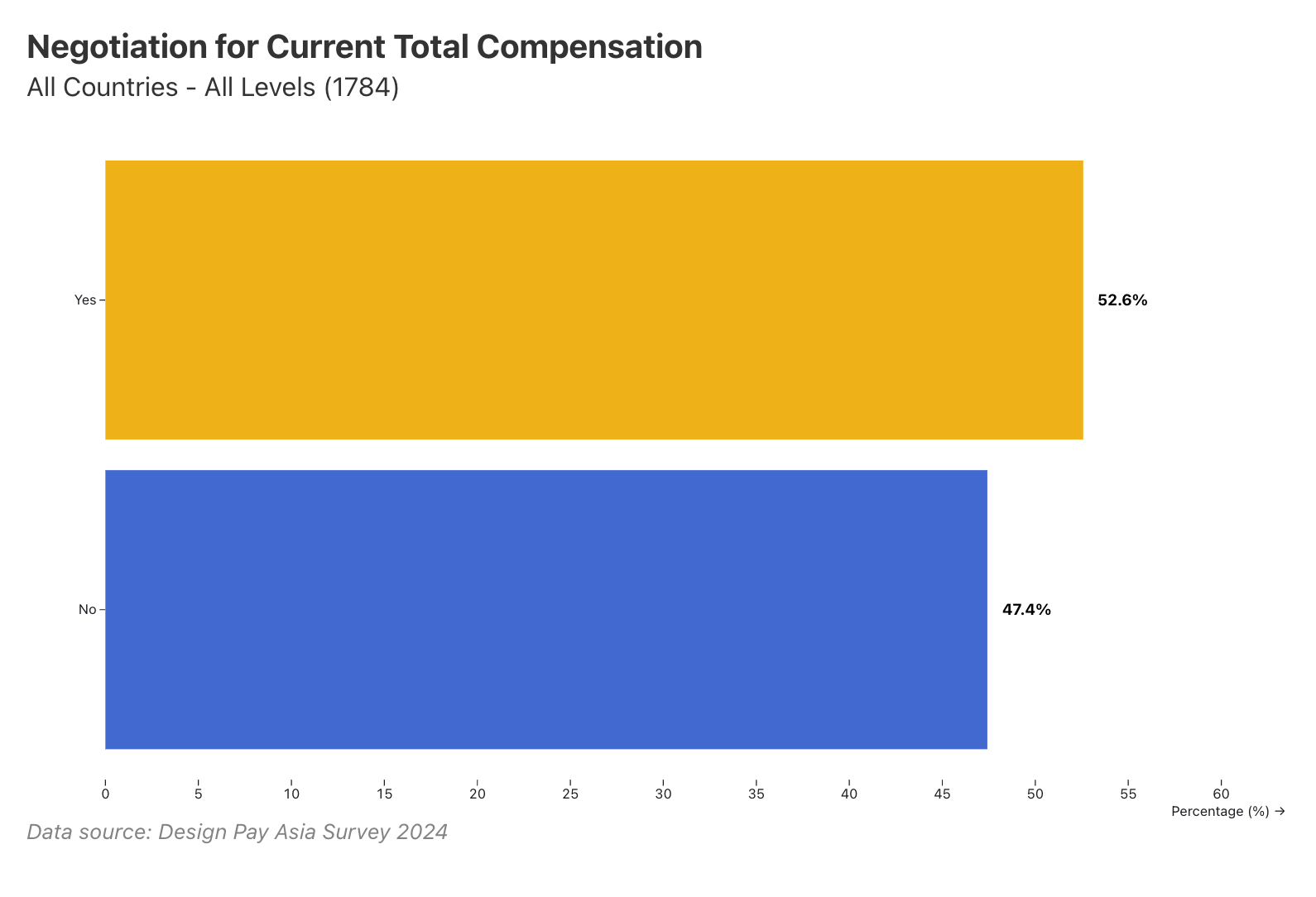
Negotiation for current total compensation
Share of designers who actively negotiate their total compensation offer.
52.5% of designers negotiate their compensation, and among those who do, 79.5% achieve some increase.
View data table
| Category | Respondents (n) | Proportion |
|---|---|---|
| Negotiate | 938 | 52.5% |
| Do not negotiate | 846 | 47.5% |
Chart proof
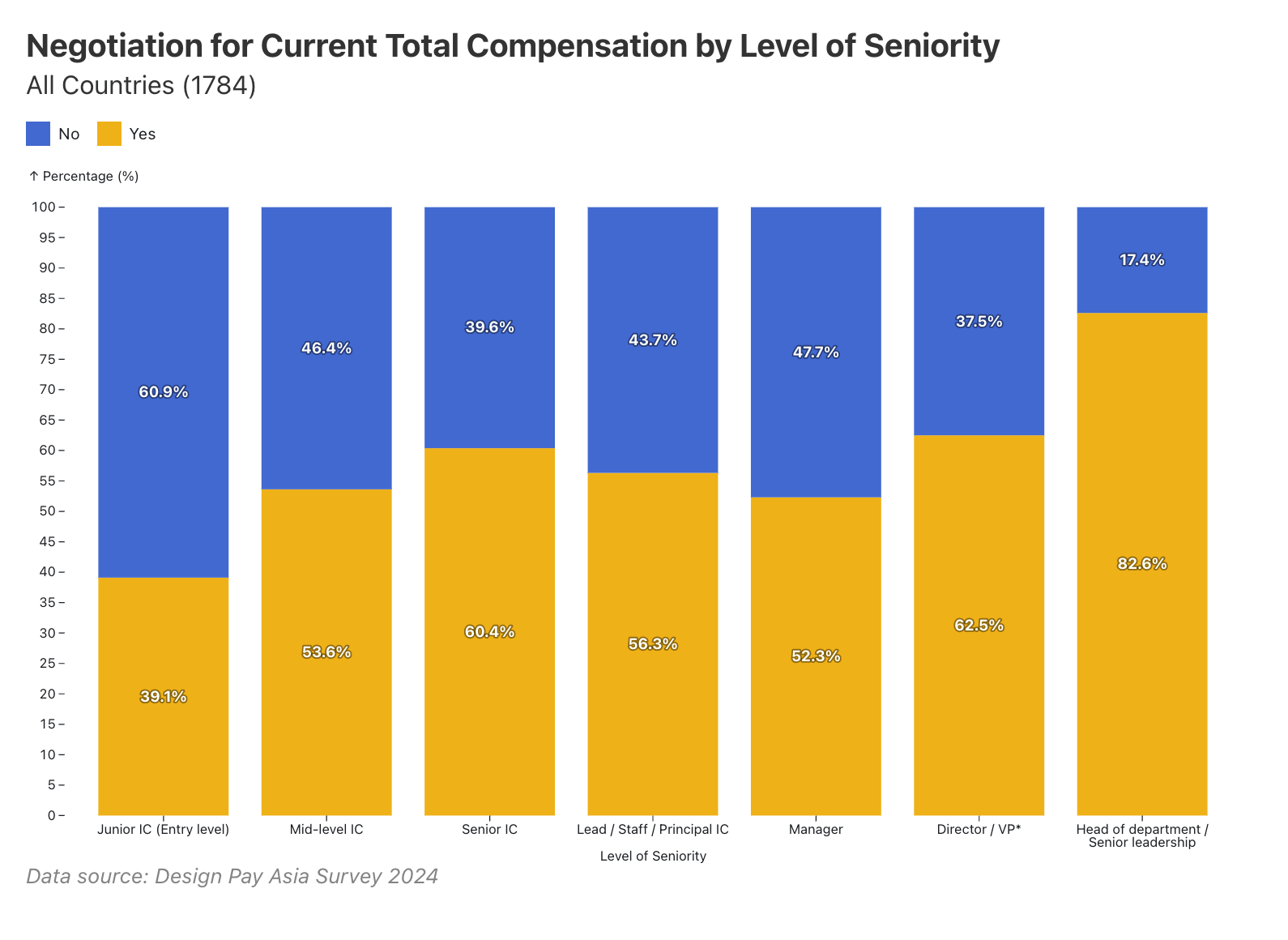
Negotiation for current total compensation by level of seniority
Negotiation rates by career stage, showing the sharp increase from junior to senior levels. Based on N=1,797 responses.
Senior leadership negotiates at 82.6%, more than double junior designers (39.1%), with mid-level at 53.6%.
View data table
| Level | Negotiation rate |
|---|---|
| Junior | 39.1% |
| Mid-level | 53.6% |
| Senior leadership | 82.6% |
Chart proof
Negotiation outcomes
Distribution of negotiation outcomes.
79.5% achieve some increase. Most common: 5–10% (25.6%). Above 20%: 19.8%. No increase: 20.5%.
View data table
| Outcome | Respondents (n) | Share |
|---|---|---|
| 5–10% increase | 239 | 25.6% |
| 11–20% increase | 183 | 20.0% |
| >20% increase | 185 | 19.8% |
| <5% increase | 135 | 15.0% |
| No increase | 191 | 20.5% |
Chart proof
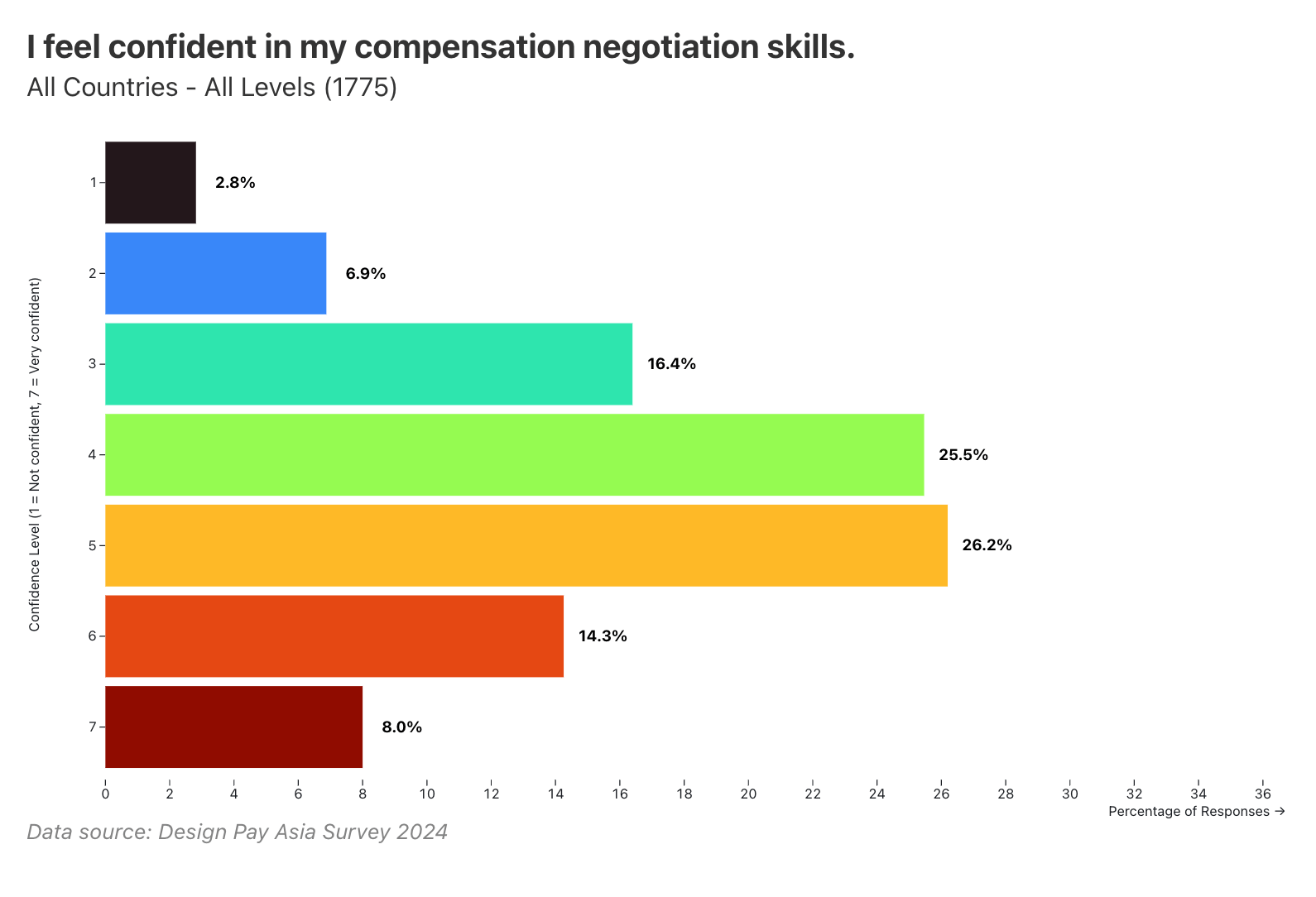
I feel confident in my compensation negotiation skills
Distribution of negotiation confidence levels (1–7 scale) across all designers. Based on N=1,775 responses.
73.9% of designers rate their negotiation confidence at 4 or above, but high confidence (6–7) is reported by 22.2%.
View data table
| Confidence level | Proportion |
|---|---|
| High confidence (6–7) | 22.2% |
| Moderate confidence (4–5) | 51.7% |
| Low confidence (1–3) | 26.1% |
Chart proof
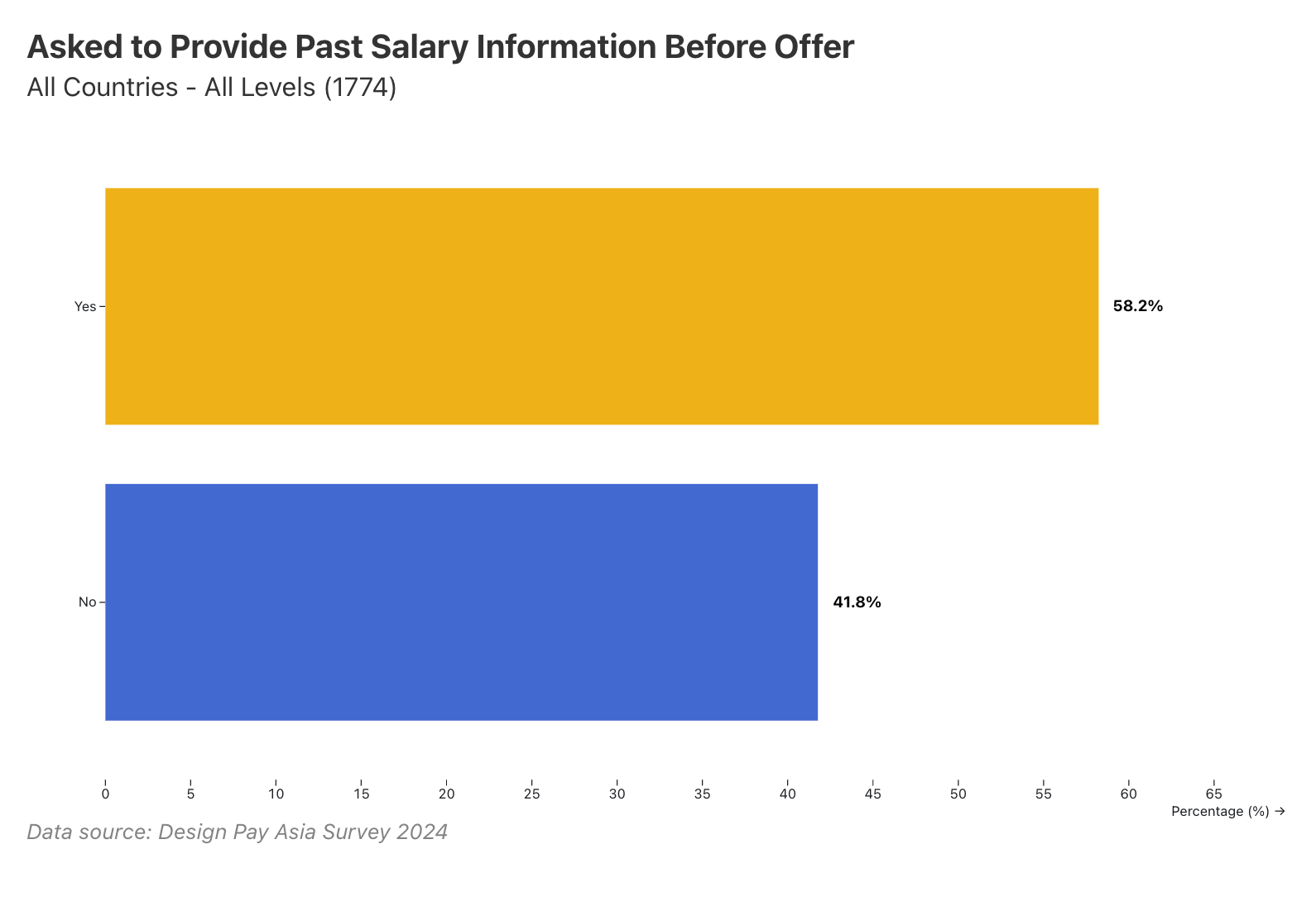
Asked to provide salary information before offer
Share of employers requiring past salary disclosure before making an offer.
58.1% of employers still require past salary disclosure before an offer, a practice that persists despite growing pushback.
View data table
| Employer requirement | Respondents (n) | Proportion |
|---|---|---|
| Required disclosure | 1,033 | 58.1% |
| No requirement | 741 | 41.9% |
Whatever the guidance says, most employers still ask what candidates earned last.
Chart proof
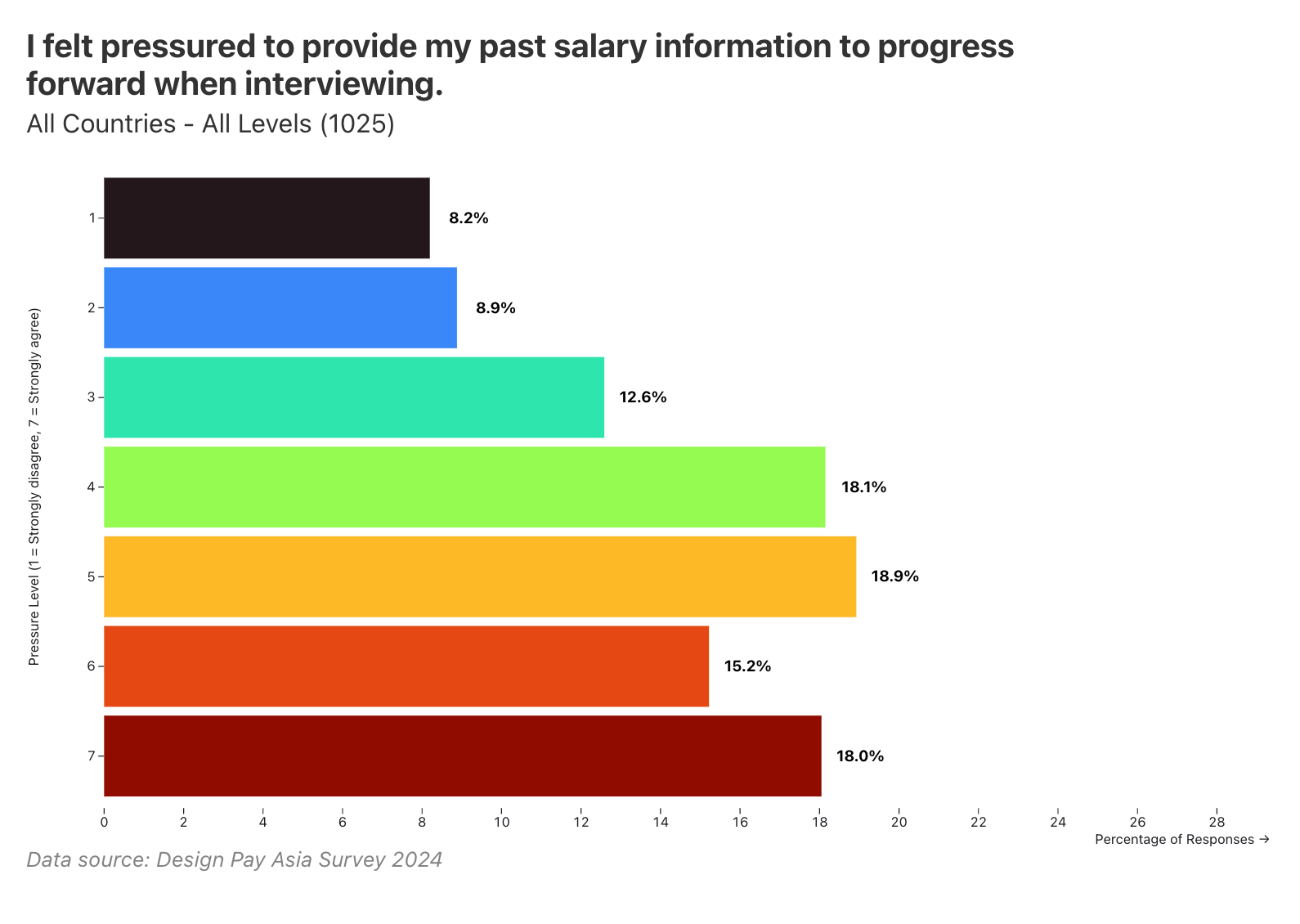
I felt pressured to provide my past salary information to progress forward when interviewing
Perceived pressure level to disclose salary history during the interview process.
70.3% of designers report moderate to high pressure (ratings 4–7) to disclose their salary history in order to progress.
View data table
| Pressure level | Respondents (n) | Proportion |
|---|---|---|
| Moderate to high pressure (4–7) | 721 | 70.3% |
| Low pressure (1–3) | 304 | 29.7% |
Chart proof
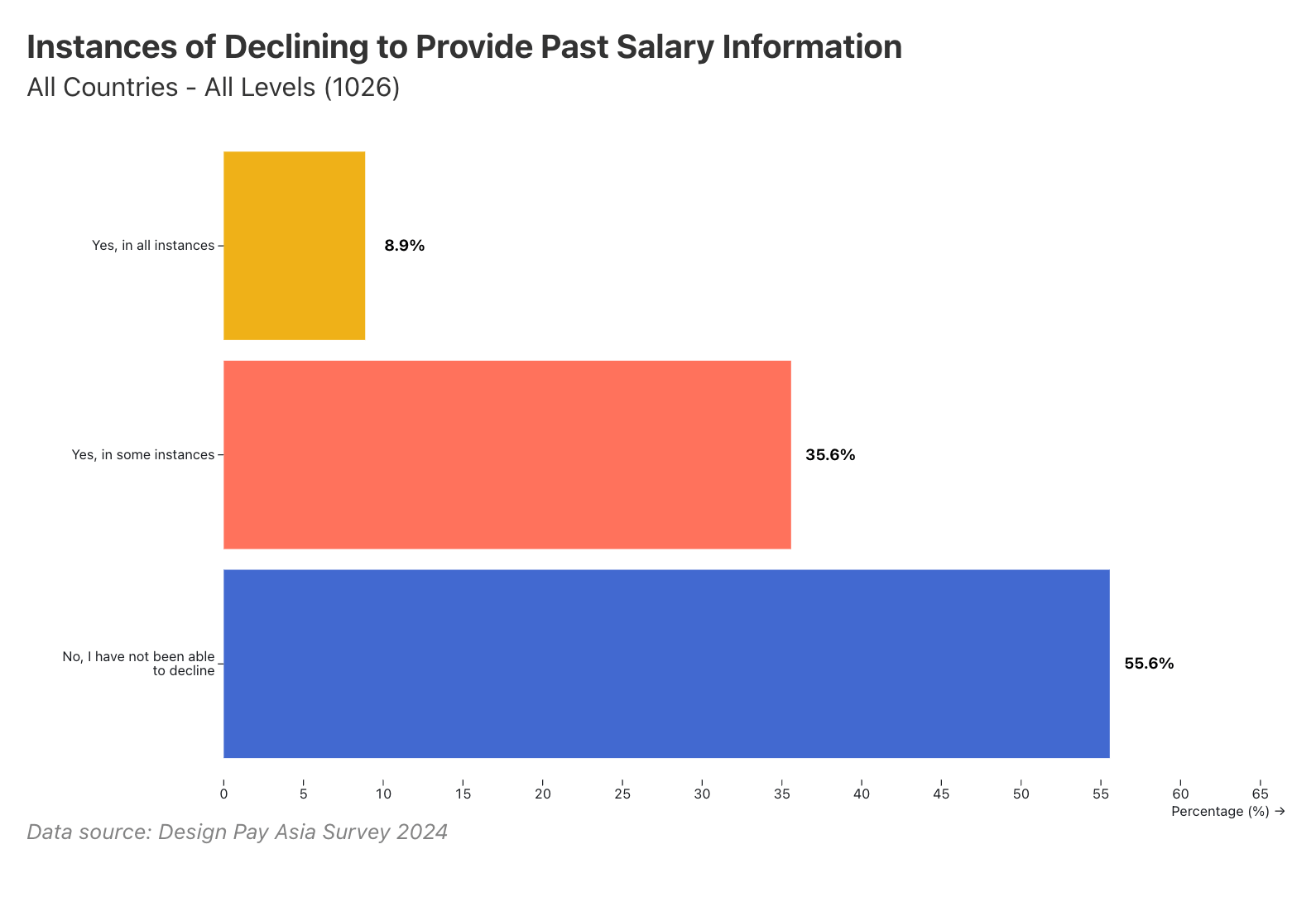
Instances of declining to provide past salary information
Outcomes for designers who attempted to decline salary disclosure.
Among the 44.4% who tried to decline salary disclosure, 8.8% consistently succeeded — 55.6% were never able to decline.
View data table
| Outcome | Respondents (n) | Proportion |
|---|---|---|
| Never able to decline | 570 | 55.6% |
| Sometimes successful | 365 | 35.6% |
| Always successful | 91 | 8.8% |
Asking is not the same as winning. One in five designers who negotiate still walk away with nothing to show for it.
What this means for you
If you're a designer
- Use market data and community knowledge to build confidence in pay discussions.
- Find ways to discuss pay that feel comfortable with your cultural values.
If you're leading a team or organisation
- Consider how your pay practices work for people from different cultural backgrounds.
- Think about how to help team members feel comfortable discussing pay.
- Consider how unclear pay ranges might affect hiring and keeping good designers.
- Weigh the costs of keeping things as they are versus being more open about pay.
Evidence and further reading
Evidence used in this section
-
52.5% of designers negotiate offers, with senior leaders 2.1x more likely
Regionally, 52.5% of designers actively negotiate job offers. Senior leaders are 2.1x more likely to negotiate than junior ICs. The typical increase achieved through negotiation is 5–10%. Salary history disclosure remains a persistent issue affecting outcomes.
Further reading and context
- Indonesia maintains traditional approach to salary disclosure
- East/Southeast Asian employees less likely to negotiate salaries due to cultural factors
- 84% of Asian firms limit pay transparency to internal audiences
- Singapore leading ASEAN in pay transparency initiatives
- Pay transparency policies shown to reduce gender pay gaps
Questions worth exploring
How will more open discussions about pay affect the previous salary plus 20 percent practice?
Worth exploring next
- What should companies do to make pay talks easier for everyone?
- How can we respect cultural differences while ensuring fair pay?
- Will budget cuts make pay differences bigger or smaller?
Where this sits in the conversation
-
Overview
2024 report -
Landscape
Demographics -
Landscape
Roles & experiences -
Landscape
Compensation -
Landscape
Company landscape -
Sentiments
Offer & negotiation you are here -
Sentiments
Career progression -
Sentiments
Value of design -
Sentiments
Job market -
Singapore deep dive
Singapore deep dive -
Close
The conversation continues
Commentary
Job offers and pay conversations show a negotiation gap.